
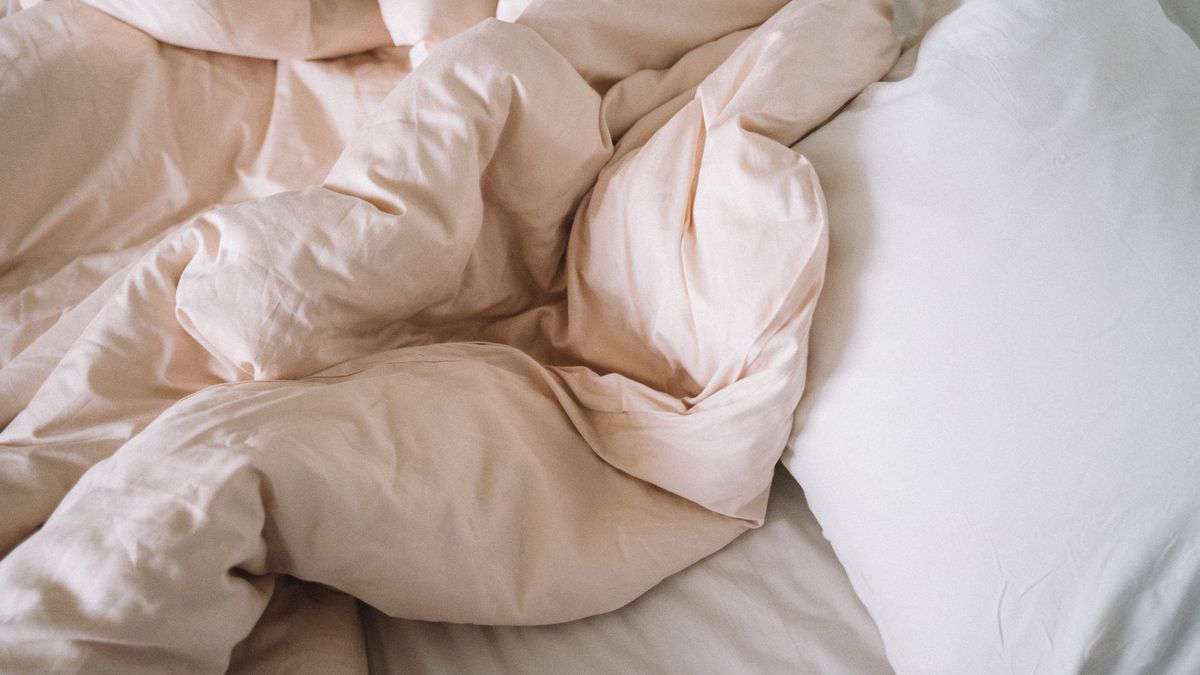
Linen and cotton sit side by side on almost every bedding shelf, and at a glance they can look like near-twins: both are natural, both breathe, both feel lovely against the skin. Yet they come from entirely different plants and behave quite differently once they are woven. Linen is spun from the stalk of the flax plant, cotton from the fluffy seed fibres of the cotton plant. Flax fibres are long, strong and slightly irregular; cotton fibres are shorter and more uniform. That single botanical difference explains almost everything that follows — how each fabric creases, how it ages, how it feels at three in the morning in July.
Knowing which is which matters if you are building a sustainable interior. Linen generally lasts longer and softens with every wash, while cotton is softer from the start but more prone to pilling and losing shape. Both can be grown and processed responsibly, but they are not interchangeable, and a label alone is not always enough.
Hold the fabric up to a window or a lamp. Linen has a low, almost waxy sheen, but its weave is often visibly uneven — small slubs, thicker threads here and there, a slightly rustic texture. Cotton tends to look flatter and more uniform, with a soft matte finish and a more regular grid of threads.
Colour is a clue too. Undyed linen is usually a warm oatmeal or grey-beige, never brilliant white. Cotton can be bleached to a crisp white with relative ease. If a "linen" sheet is dazzlingly white, be a little sceptical.
Press the fabric against the inside of your wrist, where skin is thin. Linen feels noticeably cool and dry within seconds — it conducts heat away quickly. Cotton feels neutral to slightly warm, softer and more yielding.
Now scrunch a corner in your palm and let go. Linen holds a crease like a folded paper map; cotton relaxes into softer, rounded wrinkles. This is the single most reliable quick test in a shop, and it needs no equipment at all. Linen also feels heavier and crisper for the same thickness, with a slight stiffness that eases after a few washes. Cotton feels floppier and more malleable from the outset.
If you already own the piece and can spare a thread or a drop of water, try these.
None of these is foolproof on its own, but two or three together will settle the question.
This is where the choice becomes about interiors rather than just fabric. Linen bedding begins slightly crisp, almost papery, then softens dramatically over the first dozen washes. It develops a gentle, lived-in patina and, with care, can last for decades — often handed down. It also wicks moisture and dries quickly, making it superb for warm sleepers and for summer. It will always crease, and that relaxed rumple is part of its character, not a flaw.
Cotton bedding feels cosy immediately, holds its shape and colour well, and takes dye beautifully for richer, more saturated tones. The trade-off is that it can pill, thin at stress points and lose its crispness over time. Long-staple and organic cottons resist this far better than cheaper short-staple versions.
For a relaxed, textured, long-lasting look — stonewashed linen sheets, linen curtains that filter light softly, linen cushion covers that improve with age — linen is hard to beat. It suits anyone who does not mind ironing, or who genuinely likes the crumpled aesthetic.
Cotton wins on easy care, colour range and initial softness, and it is often the kinder choice for a guest room or a child's bed where frequent hot washing is the norm. A linen-cotton blend can be a sensible middle path, giving you some of linen's texture and durability with cotton's forgiving drape. Whichever you choose, buy the best quality you can afford, wash it gently, and let time do its work. Both fibres reward patience — they simply reward it in different ways.

Hi, my name is Anthony kuber. I am artist and fashion designer.
I love to travel and writing blogging.
Your email address will not be published. Required fields are marked *
Software Developer & Writer
Hey, I'm Diva, a developer and writer blending code and creativity. I'm driven by a deep curiosity and a relentless pursuit of excellence. Join me as I craft digital solutions and captivating stories.


