
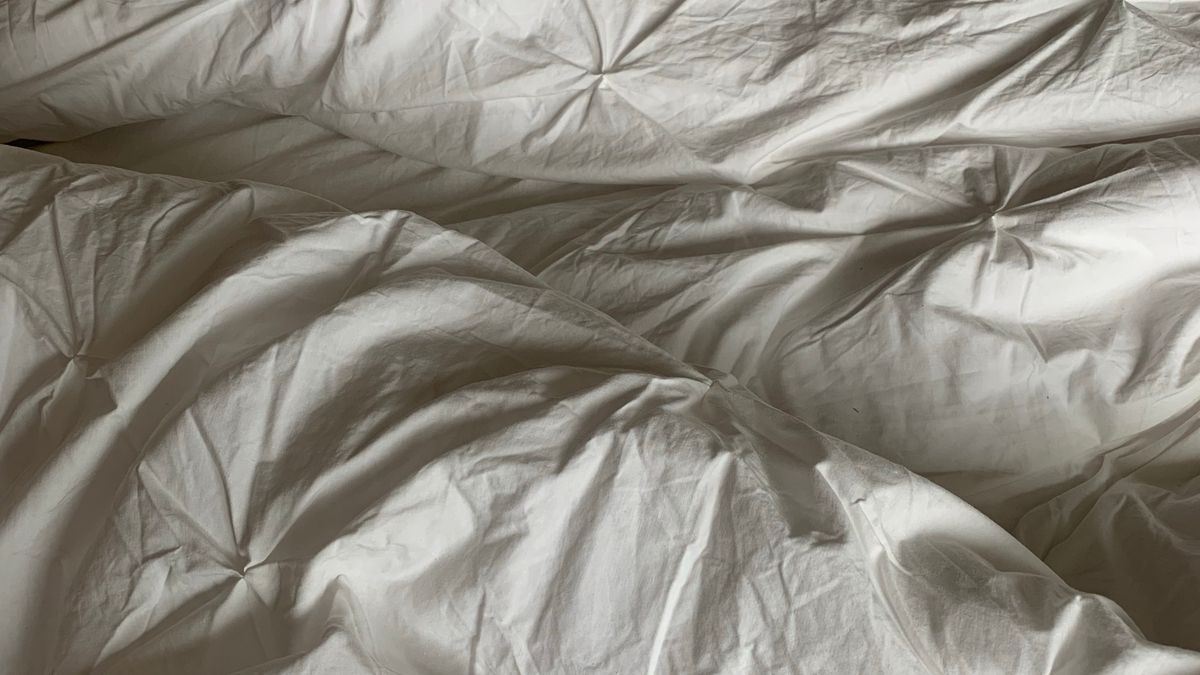
Pattern catches the eye the moment you walk in. Texture works more slowly. It is the difference between a bedroom that photographs well and one that actually feels restful when you climb into it at half past ten on a wet Tuesday.
A calm scheme rarely needs more colour. It needs more surface. Rough against smooth, matte against a faint sheen, dense against airy. Linen, wool and cotton give you three genuinely different surfaces while staying inside a narrow, natural palette, which is why they layer so well together.
A useful rule to hold in your head: three textures, two tones, one accent. Any more and the room starts to feel busy rather than layered.
Natural linen bedding earns its place as the foundation because it has a slight slub and irregularity that stops a plain bed looking flat. Look for washed European flax, and check the weight: roughly 165–190 gsm for summer, 200 gsm and above for the cooler months. Stonewashed or garment-washed linen arrives already soft, so you skip the stiff first month.
Stick to undyed or lightly dyed neutrals for the base layer — oat, chalk, dove grey, pale clay — and let the weave do the talking. If you like a crisper feel under you, a cotton percale fitted sheet beneath a linen duvet cover is a very practical pairing; linen sheets can feel loose and rumpled, which some love and others find untidy.
Cotton sits between linen and wool and does a specific job: it softens the scheme. Crisp percale has a cool, papery quality that contrasts beautifully with linen's slub, while brushed cotton brings a fuzzy, almost fleecy warmth that reads as comfort without reading as clutter.
This is the layer to fold rather than tuck. A cotton throw folded lengthways across the foot of the bed, or a cellular blanket laid over the lower half, adds volume to the silhouette. A gentle crinkle or seersucker cotton quilt is another good option if you want something you can pull up over a duvet on cold nights without fully remaking the bed.
Keep the palette here within a shade or two of the linen. If the base is oatmeal, the cotton layer might be chalk or a soft mushroom. The point is depth, not contrast.
Wool gives a bed something the other two cannot: weight. That grounding heaviness is a large part of why a wool blanket feels so calming, and it is also why a wool throw on top of a light duvet often feels warmer than a heavier synthetic duvet alone.
Lambswool, merino and undyed British wool all work well. Look for whipstitched or blanket-stitched edges, which sit flatter and avoid the curled corners you get on cheaper bindings. Fold a throw in thirds and lay it across the end of the bed, letting one edge hang slightly. In summer, swap the duvet out entirely and use a wool blanket with a linen top sheet, layering lighter weights rather than removing layers altogether.
Depth comes from tonal variation, not from lots of different colours. Choose five tones and stay inside them: chalk or bone, oatmeal, clay or terracotta, mushroom, and a soft charcoal or deep umber for grounding. Keep the darkest tone for the floor, a rug edge or a single throw, and let everything above it sit in the lighter range.
Light matters more than the swatch card. Test fabric samples against the wall at three points in the day, especially in the evening under the actual lamp you use. North-facing rooms generally want warmer, sandier tones; south-facing rooms can carry cooler greys without turning chilly. Bedrooms used only at night need testing under warm bulbs, not daylight.
Keep the accessories sparse and tactile: two square linen cushions, one long wool bolster, a linen or wool-blend curtain that absorbs sound, and perhaps a linen pendant shade. That is usually enough. Resist the urge to add a third cushion size or a decorative runner.
Care is part of sustainability. Wash linen at 30–40°C with a gentle, non-biological detergent, skip fabric softener entirely, line dry where you can, and tumble on low briefly to soften. Wool needs airing more than washing: hang it out on a dry day, spot clean, and hand wash or use a wool cycle only when necessary. Store with cedar or lavender rather than plastic.
Buying fewer, better pieces and mending them — re-stitching a hem, darning a small hole, replacing a zip — will keep a bedroom scheme looking considered for a decade. Flax needs very little water to grow, wool is renewable and biodegradable, and an undyed palette means fewer dye processes. Texture, quietly chosen, is the most sustainable kind of decoration there is.

Hi, my name is Anthony kuber. I am artist and fashion designer.
I love to travel and writing blogging.
Your email address will not be published. Required fields are marked *
Software Developer & Writer
Hey, I'm Diva, a developer and writer blending code and creativity. I'm driven by a deep curiosity and a relentless pursuit of excellence. Join me as I craft digital solutions and captivating stories.


